Frederick Mulder Ltd is delighted to return to the London Original Print Fair (LOPF) at Somerset House from 14 to 17 May 2026.
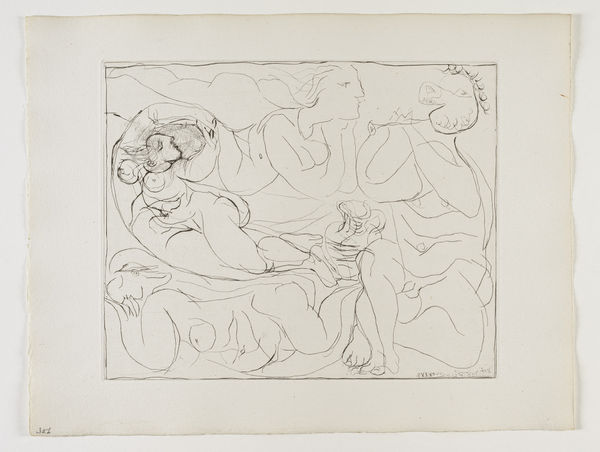
We will present a small, carefully selected group of individual impressions from the Suite Vollard by Pablo Picasso (1881-1973), alongside a group of prints that exemplify the artist’s linocut practice. Though distinct in period, style, and technique, both the linocut Tête de Femme de profil and our impressions from the Suite Vollard look back to the classical tradition. In L'Aubade, avec Femme Accoudée, with just a few assured strokes of the gouge, Picasso captures the visual essence of courtly love, recognisable as a universal motif since the 12th century, when Eleanor of Aquitaine patronised troubadours and their poetic tradition. L'Aubade, avec Femme Accoudée is at once faithful to the past and a distinctly modern reinterpretation, both intimate in scale and universal in resonance.
Our three states of Femme à la Source illuminate Picasso’s creative process in arriving at a final composition, while the unique proof of Grand Nu debout stands as a compelling testament both to the artist’s early engagement with linocut and to the spirit of experimentation that permeates his oeuvre.
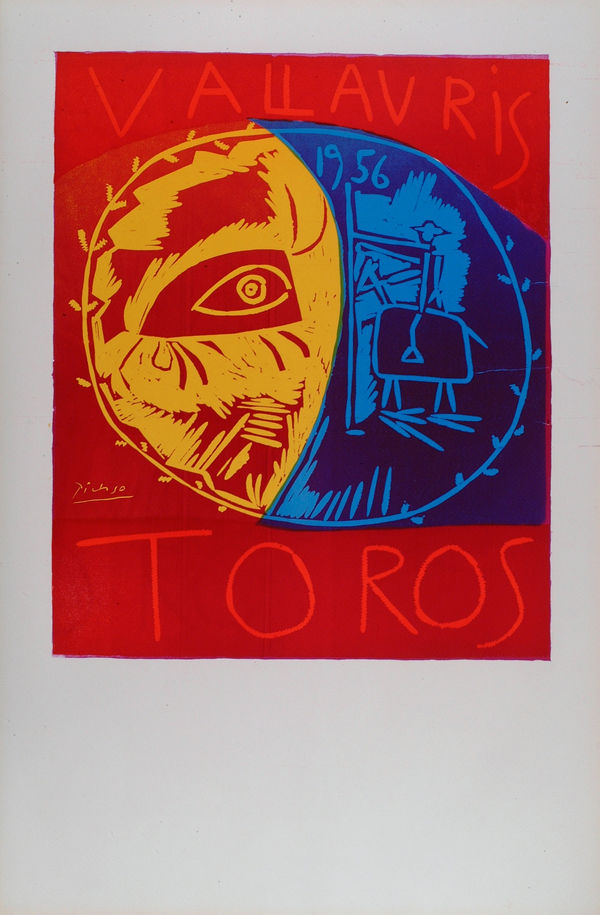
We will also present a group of vintage posters advertising Picasso exhibitions, including one dating from 1959. These share with Picasso’s prints the distinction of having been produced by Imprimerie Arnéra, the printer responsible for the artist’s linocuts.
For this edition of LOPF, we are delighted to partner with Stephen Chambers RA, who will present his latest series, The Pomeranian Trees. Over the past six years, Chambers has undertaken repeated journeys from Berlin northeast to West Pomerania, adjacent to the Oder Delta. These journeys, made across the seasons, traverse a stark and expansive landscape: flat, wind-swept, and defined by a sharply drawn horizon. Largely depopulated in the mid-20th century and shaped by a complex subsequent history, the region has, in many respects, been left to return to a state of wilderness.
We look forward to welcoming you to our stand W4 located in the West Wing. Please click here to request a complimentary ticket - subject to availability, or contact us via the enquiry buttons below.
-

-
-
-
-
Note
Cut on 9 September 1959 by Pablo Picasso, the reclining pose and nakedness of the woman of 'L'Aubade, avec Femme Accoudée' reveal a lineage to traditional representations of Venus and odalisques by the Old Masters; an inspiration to which the artist turned increasingly at the end of the 1950s. However, despite the male figure being clothed and active in playing music, the voyeurism and latent sensuality that would be inherent in such compositions, and in many of Picasso's works in his earlier years, are not present here.
The linocut has no erotic undertones and rather projects a feeling of gentle courtship. A young man serenades his loved one. An aubade is a love poem or song greeting (or lamenting) the arrival of the dawn, often concerning the parting of lovers. The form originated in medieval France at the onset of amour courtois or courtly love in the 12th century, and gained ground throughout Europe thanks to Eleanor of Aquitaine and her daughter Marie, Countess of Champagne, as well as the travelling troubadours. In The Allegory of Love in 1936, C.S. Lewis defines courtly love as a "love of a highly specialized sort, whose characteristics may be enumerated as Humility, Courtesy, Adultery and the Religion of Love".
Establishing a dramatic rhythm through the woman's impossible swirling forms that equally underline her grace, Picasso depicts her with head up and in control of her poise and nakedness as a goddess would be. She intently gazes at and listens to the man playing music. He is clothed in a bullfighter's costume, and most certainly is a picador, for he wears spurs - though here again, Picasso deflates traditional meaning through visual artifices; the spurs look more like flowers, and the man's body in its roundness resonates with that of his loved one.
In a few master strokes of his gouge, Picasso realises the visual essence of a moment recognisable as a universal symbol of love since the 12th century. 'L'Aubade, avec Femme Accoudée' is both faithful to the past, and a modern artistic reinterpretation. It is both intimate and universal.
-
-
-
Progressive set of 'Femme à la Source'
A very interesting group for understanding the creative methodology by which Picasso, with the close involvement of his printer, worked his way in linocut towards a finished image.
Three impressions in all: the first, second, and third and final states, each materialising the steps of the creative process followed by Picasso in achieving his final composition.
-
Note
The subject of Femme à la source constitutes a deliberate evocation of both Édouard Manet (1832 - 1883) and Jean-Auguste-Dominique Ingres (1780–1867). Although the title assigned by Brigitte Baer makes no explicit reference to either artist, the composition unmistakably engages with the numerous variations on Le Déjeuner sur l’herbe produced by Pablo Picasso.
In Femme nue cueillant des fleurs. Variation sur le “Déjeuner sur l’herbe” de Manet (20 April 1962), Picasso isolates the bending female figure from the background of Manet’s original composition, divests her of clothing, and renders her in the act of leaning forward. On that same day, he produced the present work, endowing the figure with a closely related pose. The near-frontal depiction of the body, combined with the slight inclination of the head, either upright or turned to the left, constitutes a recurrent formal motif within Picasso’s Déjeuner series, manifest across paintings, drawings, and linocuts alike. Between June 1954 and October 1962, Picasso executed 26 works engaging with Le Déjeuner sur l’herbe, five of which take the form of linocuts.
Moreover, in Femme à la source, the placement of the figure between two masses, together with her nudity and poised stance, imparts a pronounced sense of stillness, evoking the immobility of statuary. This effect combined with the prominence of the flower at her left and the stylised rendering of the flowing spring are elements that strongly recall La Source by Ingres.
-
-
Stephen Chambers, The Pomeranian Trees
Stephen Chambers (b. 1960) is a British artist who was elected a Royal Academician by the Royal Academy of Arts, London, in 2005, and was awarded an Honorary Fellowship by Downing College, Cambridge in 2015. Chambers is renowned for his distinctive approach to both painting and printmaking, which run in parallel. Each share a similar identity that is unquestionably 'his', characterised by highly imaginative imagery and a use of colour and pattern that creates a rich visual texture. His work often explores themes of human experience, relationships, and mythological references, employing a visual language that balances abstraction with figuration. His work is held in many public collections, including the Metropolitan Museum of Art, Tate, The British Museum, the Bibliothèque nationale de France, and The Chinese National Museum of Fine Art.
Each of Chambers’s sets of prints stems from ideas that demand their own solutions. He has no interest in prints reproducing his paintings. He describes his various series of prints as “chapters,” with each chapter, each set of prints, articulating a specific idea, and each idea being assigned its own process. He has frequently expressed an interest in empowering the practice of print, an oft-maligned and marginalised area of contemporary art. Collaborations with printers provide a counterbalance to the more solitary time spent painting. Chambers has worked in multiple studios around the world, collaborating closely with master printmakers. Some of his most prominent projects include Stealing Shadows, My Shitty Sisters, The Talking Trees of England, I Bite & Sting, and The Outliers. In 2012, for an exhibition at the Royal Academy of Arts, he produced a vast multi-panel silkscreen over 20 metres in length, The Big Country—a personified map of human migration passages across time.
He currently lives and works in London and Berlin.
Follow Stephen on Instagram: @stephenthepainter
-
-
-
-
-
-
-
-
-
-
-
-
-
-
-
-
-
Vintage posters - prices ranging from £50 to £200
-